So Apple makes Final Cut Pro and Apple’s Audio Unit validation check finds some of Apple’s AU plugins are incompatible… 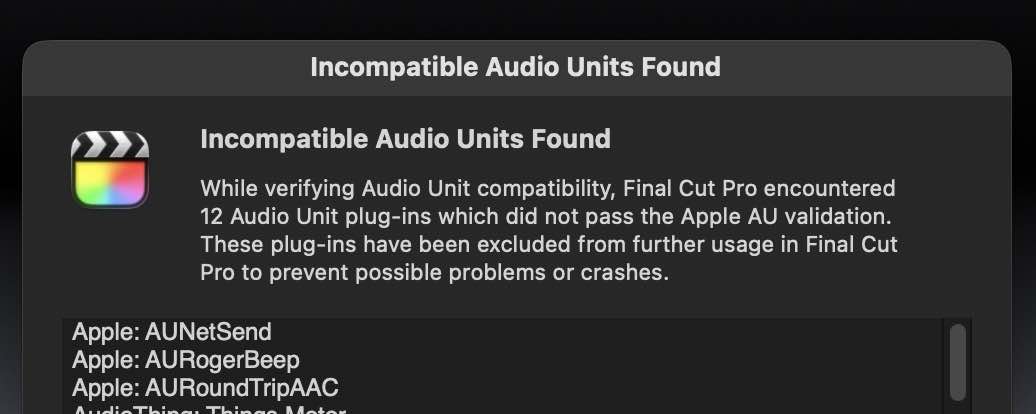
Hmmmm!

Passing clouds of inconsequential observations
So Apple makes Final Cut Pro and Apple’s Audio Unit validation check finds some of Apple’s AU plugins are incompatible…
Hmmmm!
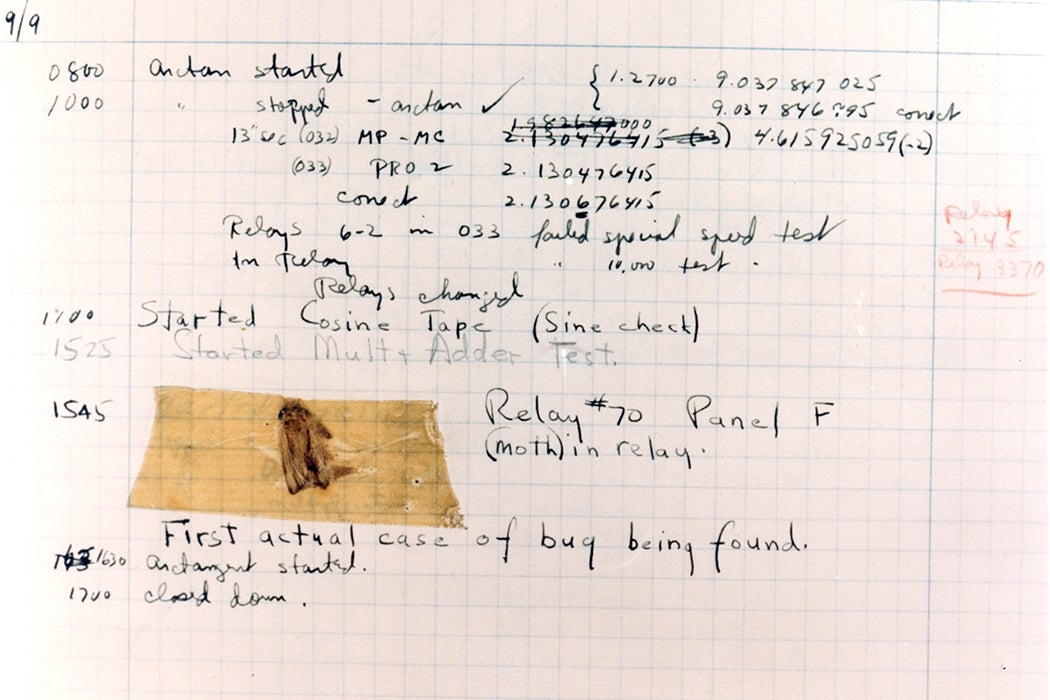
On Richard Osman’s House of Games this evening we were informed of the interesting fact that a moth once found inside a computer is why computer bugs are so called.
It is a good story but it is not a fact.
The word bug had long been used to denote some form of malfunction – as in a film from several years before the moth was found:
1875
The biggest ‘bug’ yet has been discovered in the U.S. Hotel Electric Annunciator.
Operator 15 August 5/1Citation details for Operator1889
Mr. Edison, I was informed, had been up the two previous nights discovering ‘a bug’ in his phonograph—an expression for solving a difficulty, and implying that some imaginary insect has secreted itself inside and is causing all the trouble.
Pall Mall Gazette 11 March 1/1
If we are feeling fanciful we might find ourselves in the land of the Fairies where we might encounter a mischievous Welsh Bwgan up to no good.
So when the moth was discovered it was duly noted that an actual bug had been found rather than the mythical one that had long been blamed for such malfunctions.
It is a good story so it is a shame to waste it.
Jason Snell refers to a post by Norbert Heger about how hard it can be to resize a window.
I keep seeing such articles about some daunting problem and can only assume that the writer is using some specific configuration and/or software that is causing their difficulties thus most of us never see such. I guess most readers just shrug and move on never having experienced such a problem.
It is not difficult to resize a window in macOS Tahoe. Move the mouse pointer over the edge of the window and it changes to a double headed pointer. Over a side edge this will indicate that you can resize it by dragging left or right. Over the top or bottom edge it indicates an up or down movement is required and over a corner a diagonal movement will result in the window resizing as expected. In his article Norbert Heger suggests he has to click outside the window. Such a click will move the focus to the Finder or whichever app is lurking behind.
Mac mini M2 Pro. macOS Tahoe 26.2. Studio Display 2560 x 1440.
Writing about the shortcomings of Keir Starmer (of which there are many), Ian Dunt observed that
…the prime minister themselves needs a broader, managerial, storytelling approach. They are the poetry, not the prose
This is my concern about the Green party’s leader Zack Polanski. He is certainly a splendid storyteller and can paint a vivid political poem but beyond that are there the people prepared to roll their sleeves up and get down to crossing the i’s and dotting the t’s to make things actually happen?
Update 22nd December 2025: Today Megan Kenyon writing for The New Statesman explains “How the Green Party is professionalising”.
The Buckinghamshire Archives said…
We’ve had a few enquiries come in after chatbots told researchers that we hold documents we don’t actually look after
…in response to a warning from the ICRC about AI nonsense-bots generating fabricated references because they are designed to spew out something that looks like an answer even if there is no answer available.
Having fallen down a family history rabbit hole recently it seems that such erroneous content is not limited to AI bots.