F is for Fish Finger Butties

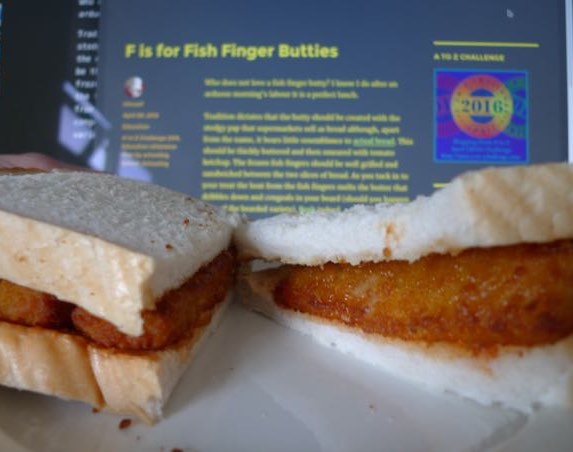
Who does not love a fish finger butty? I know I do after an arduous morning’s labour it is a perfect lunch.

Tradition dictates that the butty should be created with the stodgy pap that supermarkets sell as bread although, apart from the name, it bears little resemblance to actual bread. This should be thickly buttered and then smeared with tomato ketchup. The frozen fish fingers should be well grilled and sandwiched between the two slices of bread. As you tuck in to your treat the heat from the fish fingers melts the butter that dribbles down and congeals in your beard (should you happen to be of the bearded variety). Bosh indeed.


E is for Education

Who does not love learning something new? I know I do and these days we have so many opportunities to satiate our lust for learning. Alas for most children they do not get to learn very much as they go to school. Why this is still the case remains a mystery. There can be no logical reason for herding children together who have nothing in common other than the fact that they were born around the same time and live in the same area. It is a patently silly idea that has never worked and never will work. Successive governments keep coming up with some novel idea they claim will make it work – usually involving doing more of what is not working now… more testing, longer hours, shorter holidays etc.

Learn!

Fortunately here in the UK one need not bother with such nonsense. The law requires that parents provide their children with a suitable education. This can be in any form that suits the child and the family. Attendance at school is not a legal requirement. The original thinking was that there would be an education service along the lines of the health service – available to all as and when required.

A good school, in short, is not a place of compulsory instruction, but a community of old and young, engaged in learning by co-operative experiment.

The Hadow Report (1931)

Such a radical idea was crippled by the machinations of the church, existing school system and the limitations of post war funding and was, alas, never realised in the 1944 Education Act and that “triumph for progressive reform” was a pallid interpretation of what was envisaged and possible.

One looks forward to the day when the nonsensical schooling system is disrupted and we can start to build something better.

D is for Disabling Ad Blockers

Who does not love the Internet? I know I do apart from all the advertising that people keep sticking on it. Fortunately one can be spared the worse excesses with a range of Ad Blockers (link for extensions to Safari on a Mac but there are similar offerings for all browsers/systems). But now sites are detecting the Ad Blockers and asking you to turn them off.

Ad Block Off request

If this is a site that you particularly want to support then disabling the Ad Blocker may be good choice but for most sites the same content can be found elsewhere and we do not particularly need it regurgitated from here and so can just leave.

It is not a one way thing as the delivery of the advertisements cost us money as they are consuming the bandwidth of our Internet connection. On mobile network this can start to add up. A recent survey found that at its worse to load 4 megabytes of actual content you had to download 15.4 megabytes of advertising at a cost of $0.32 rather than the $0.08 you planned to read.

Factor in that the sites usually have no control over what advertising is displayed as advertisers bid for your attention in instant auctions so leaving the whole system open to be exploited as a delivery mechanism for malware and there is little reason not to block the ads.

If asked to Disable your Ad Blocker – Just Say No!

Free Bonus D: In my catalogue D is also for De La Soul. Who doesn’t etc….

C is for Caravan (with a drum solo)

Who does not love listening to Duke Ellington’s classic tune Caravan? I know I do and with its driving rhythm and ample opportunity for noodling one never tires of hearing a new version. The tune was written by Ellington and Juan Tizol in the 1930’s. Here they (Ellington – piano, Tizol – valve trombone) are performing it in the 1950’s…

The Mills Brothers vocalised it..

https://www.youtube.com/watch?v=MJOs8roE94E

..and countless others have created their own variations…

The Carpenters (Karen drumming)…

Guitarists Les Paul and Chet Atkins

Drummers Buddy Rich (with Harry James)

https://www.youtube.com/watch?v=NY5v4Lk-_gQ

and Gene Krupa

…and it was featured in the recent film Whiplash

Such was the tunes popularity that bands were often requested to play it. Frank Zappa alludes to such a request on the first Mothers of Invention‘s album Freak Out! in the song You’re Probably Wondering Why I’m Here and again in America Drinks & Goes Home on their next album Absolutely Free.

One may surmise just which Caravan with a drum solo was being referenced in the request. As John French recalled “Every lounge act in the sixties played Caravan with a drum solo. It was as standard as Louie Louie later became and achieved the status of a “running joke.” and Zappa related the origin of the quote “When we worked at a gig in El Monte some drunken buffoon in the audience requested it: ‘I wanna hear Caravan with a drum solo!’ There are certain things you remember from your career, like that line.”

But for my money it could only have been the definitive version of Caravan with a drum solo by The Ventures recorded live in Japan in 1965

https://www.youtube.com/watch?v=SZ2hIO6XqBw

B is for Bread

Who does not love the smell of baking bread? I know I do and every other day I am mixing up the sourdough ready to go. The mixture is flour and water with a sprinkle of salt and a splash of oil. In the place of yeast you use what is known as a starter which is itself flour and water that has been left to develop into a microscopic battleground between bacterias and natural yeasts. This can sometimes seem like a chemistry lesson…

A starter prepared from scratch with a salted wheat-rye dough takes about 54 hours at 27 °C (81 °F) to stabilise at a pH between 4.4 and 4.6. 4% salt inhibits L. sanfranciscensis, while C. milleri can withstand 8%.

…or a history lesson as people make bizarre claims for the longevity of their starter. But if you just remind yourself that millions of people have been doing this for thousands of years without knowing any of that stuff you will be fine and it is really easy…
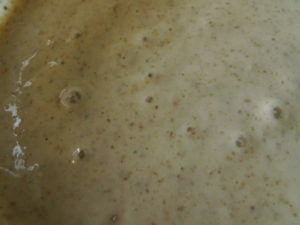
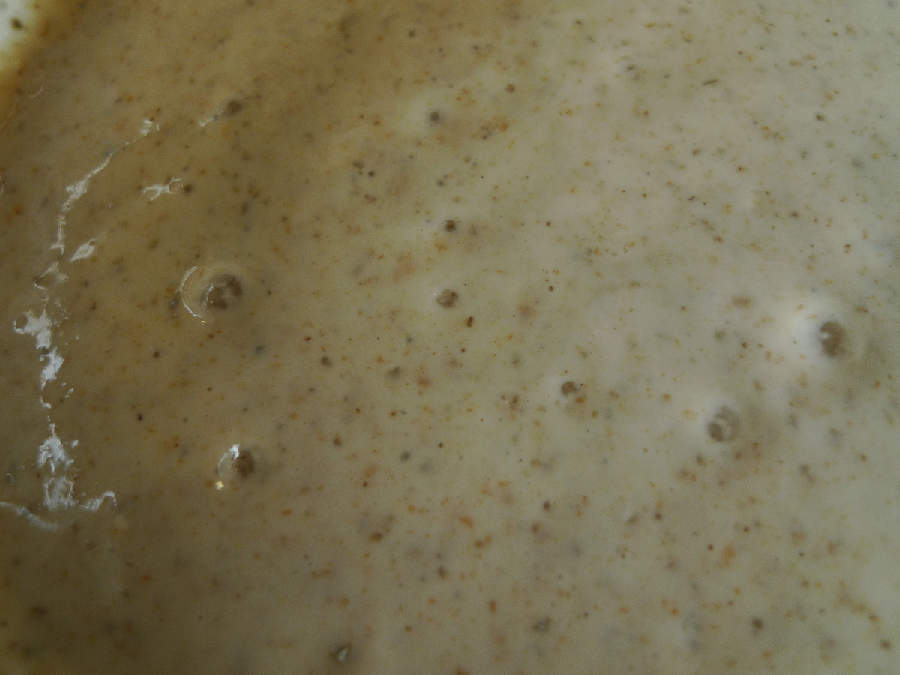
Bubbling starter

To start the starter mix some flour and warm water in a one pint bowl to a fairly thick batter and leave it out for a couple of days until it starts to bubble and looks lively. You need to feed your starter with fresh flour and warm water. If you are not using it regularly throw half of it away and top it up with a feed once a week. It can live in the covered bowl kept in the fridge to slow its growth rate.

To make some bread get the starter out of the fridge and let it warm up for an hour or two. Then give it a feed with some fresh flour and warm water. Once it starts to bubble up it is ready to go.

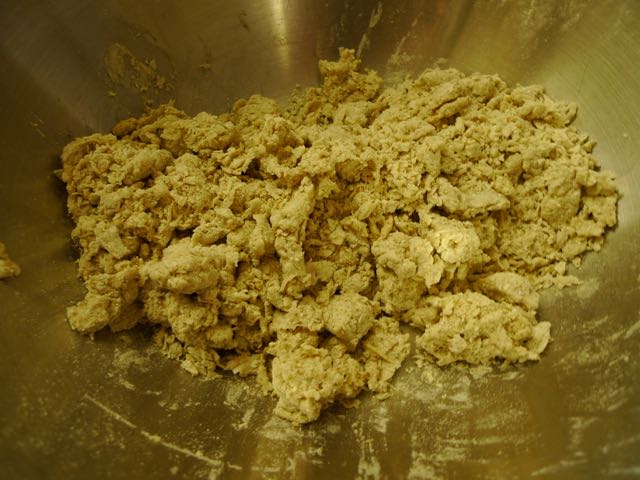
Chuck around one pound (454 g) of strong bread flour in to a big bowl and add a good dollop (2 handfuls – yes it is a messy business) of your starter. If you want to do it properly you weigh out your flour and add everything else as a percentage of that weight. I rub the starter in to the flour as you would rub the fat when making pastry.
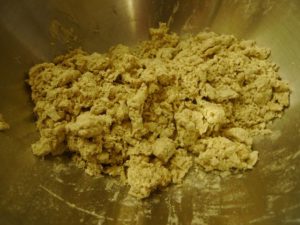
Starter rubbed in to the flour

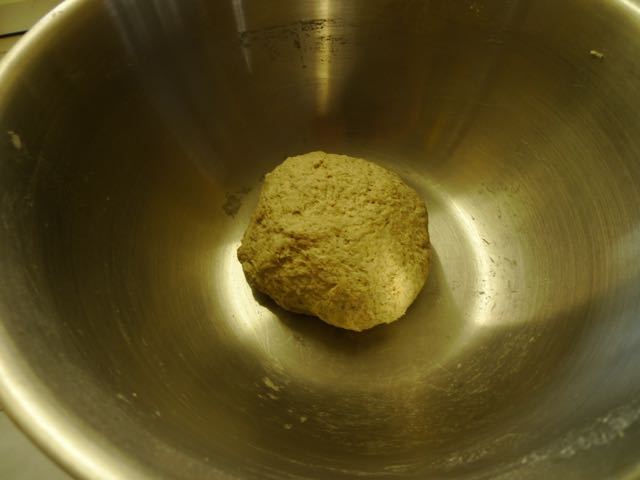
To this add a sprinkle of salt and a splash of oil if required. Then add some warm water to stick it all together to form a soft dough – better to be too wet than too dry as you can add more flour. Kneed your dough for a few minutes to make a nice smooth ball and then leave it for several hours – overnight works for me.
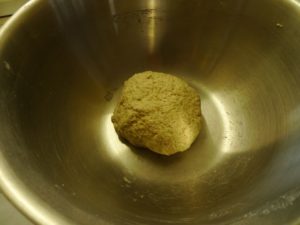
Dough ball

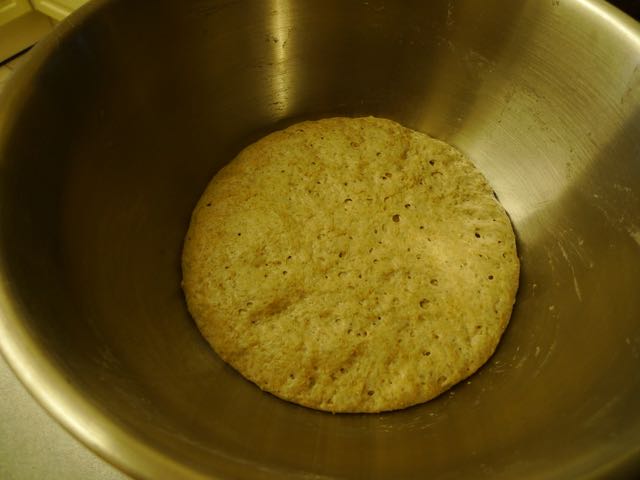
When you return to it there should be some noticeable growth.
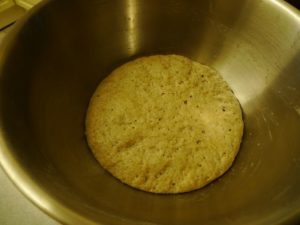
Growing dough

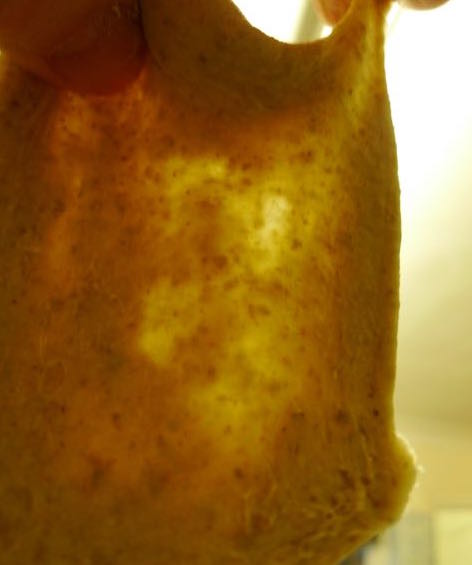
Kneed it for around 7 minutes (this depends on the temperature/humidity of your kitchen etc.) and the dough should become quite stretchy. You can stretch it in to a long strip and fold it back over itself a couple of times to relieve the kneading strain. You are building up the microscopic structure of the bread and so the more criss-crossing strands you have the better. With a good structure you should be able to stretch the dough out thin enough to see light coming through it without any holes forming.
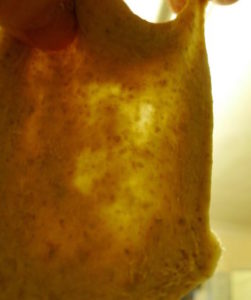
See the light

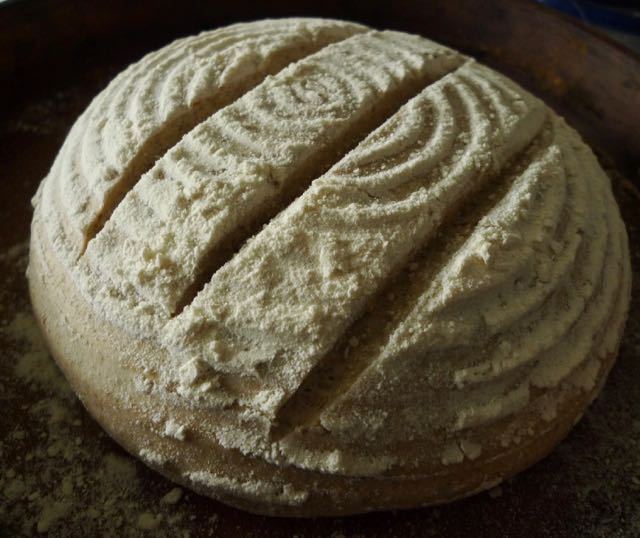
You can now shape your loaf and leave it for an hour to puff up a bit. You can put it in a loaf tin, a banneton or, with a fairly firm dough, form it in to the desired shape free hand. Slash it with a sharp blade to let the steam out while it bakes.
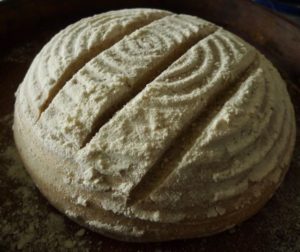
Slashed dough

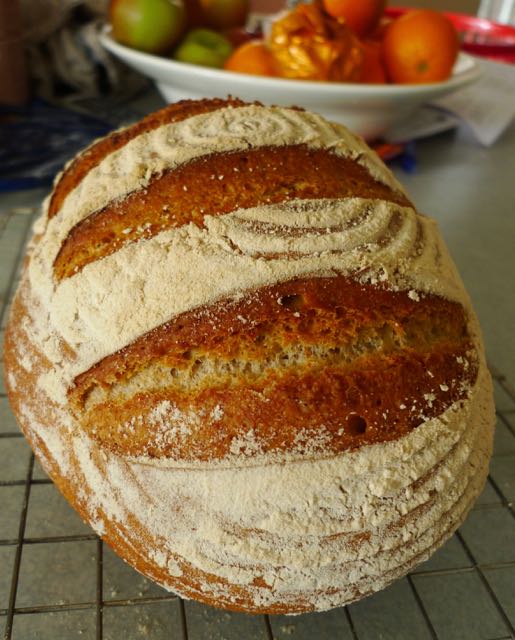
Put the oven on high (hotter than hot setting) and when it is really hot pop the bread in and bake for 45 – 55 minutes – reducing the heat half way through. You will then have a loaf full of yummy goodness.
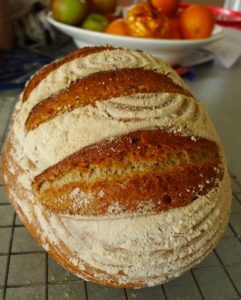
A loaf

Experiment. There are countless recipes and pages of advice but non of them are working in your kitchen with that flour you are using. See what works for you. You will get to know the feel of good dough. Even a bad loaf gets eaten.