Crosser Country

Despite the crew’s best efforts and frequent apologies there is always a sense of excitement tinged with trepidation when one travels on a CrossCountry train. Will you actually arrive at your destination or will the train break down halfway? Will the train be so overcrowded that it should be condemned as a danger to life? Will there be an announcement that the train will not fully complete the journey and you need to sprint around the labyrinthian concourse of New Street to board another CrossCountry train which may (fingers crossed) get you home?

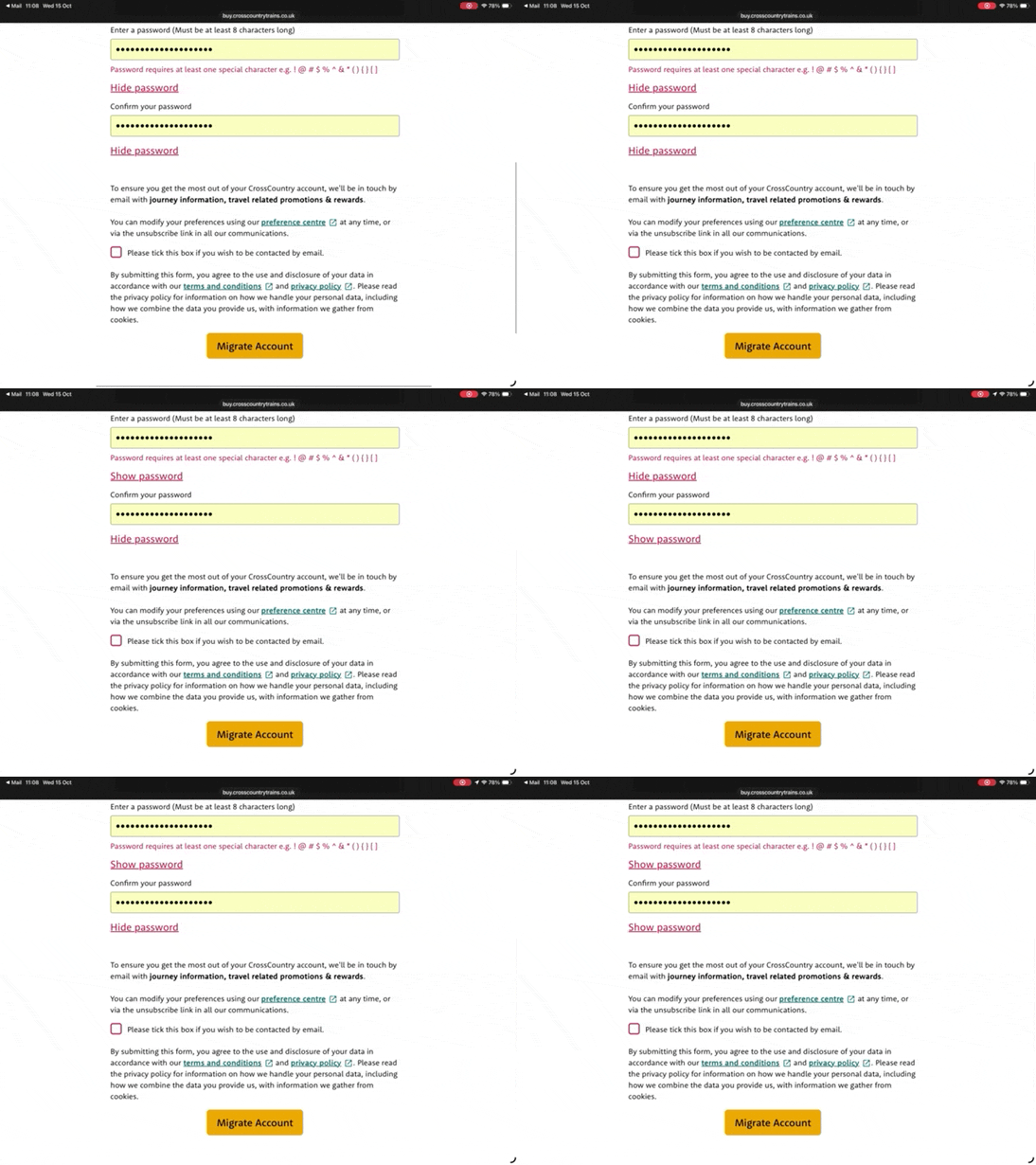
To reflect such abysmal service they have updated their app to one of those not-quite-an-app-not-quite-a-website abominations. It works exactly as you would expect. First you must change your password. Your new password, comprising a lengthy sequence of random characters, will be rejected if it does not contain a “special character” even if there is actually nothing special about those particular characters within a lengthy sequence of random characters. Helpful links are provided to show and hide your password. This, as they fail to explain, will do nothing if your cursor is not in the text box.

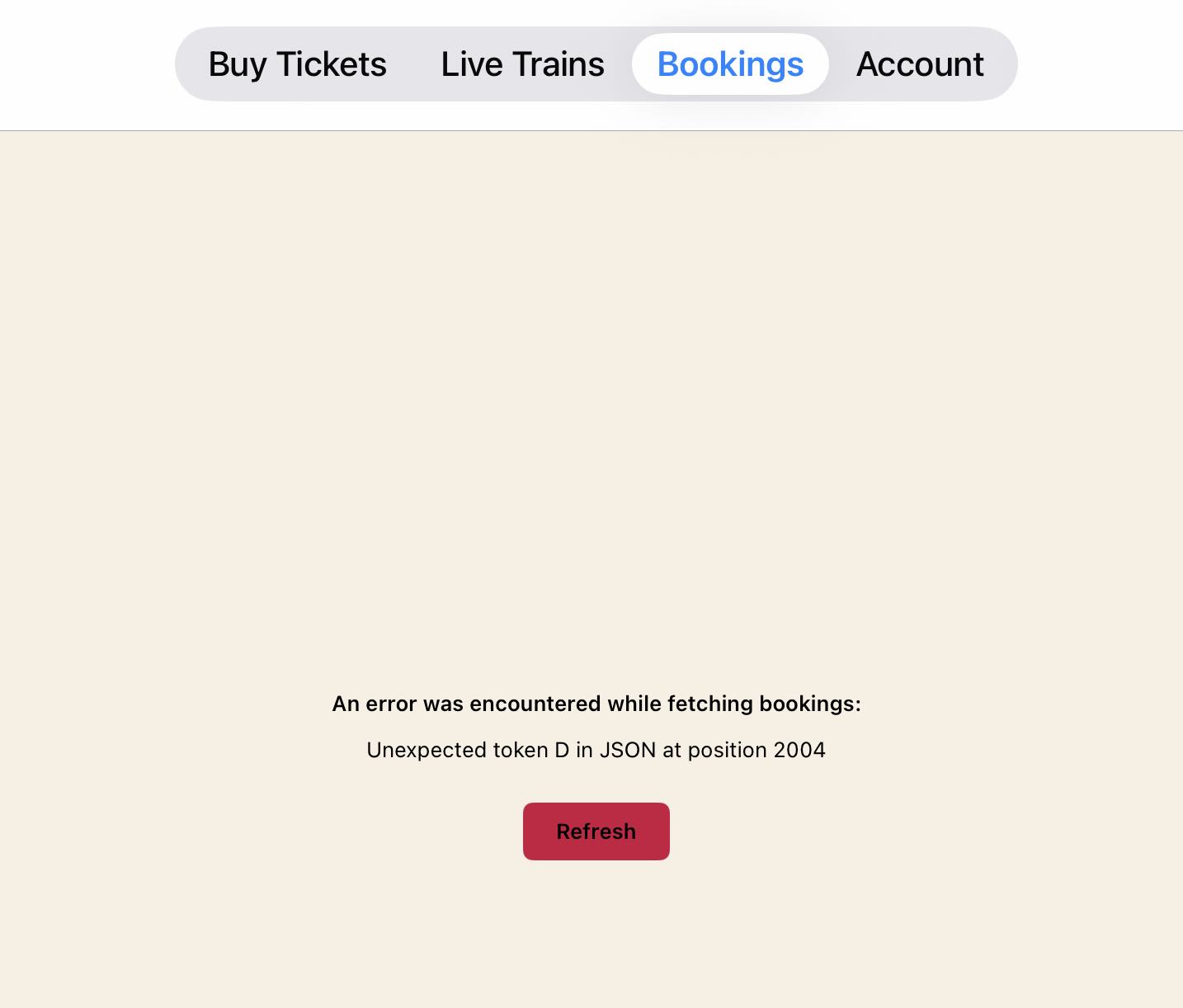
But once we have overcome such challenges we can finally log in to the shiny new app:

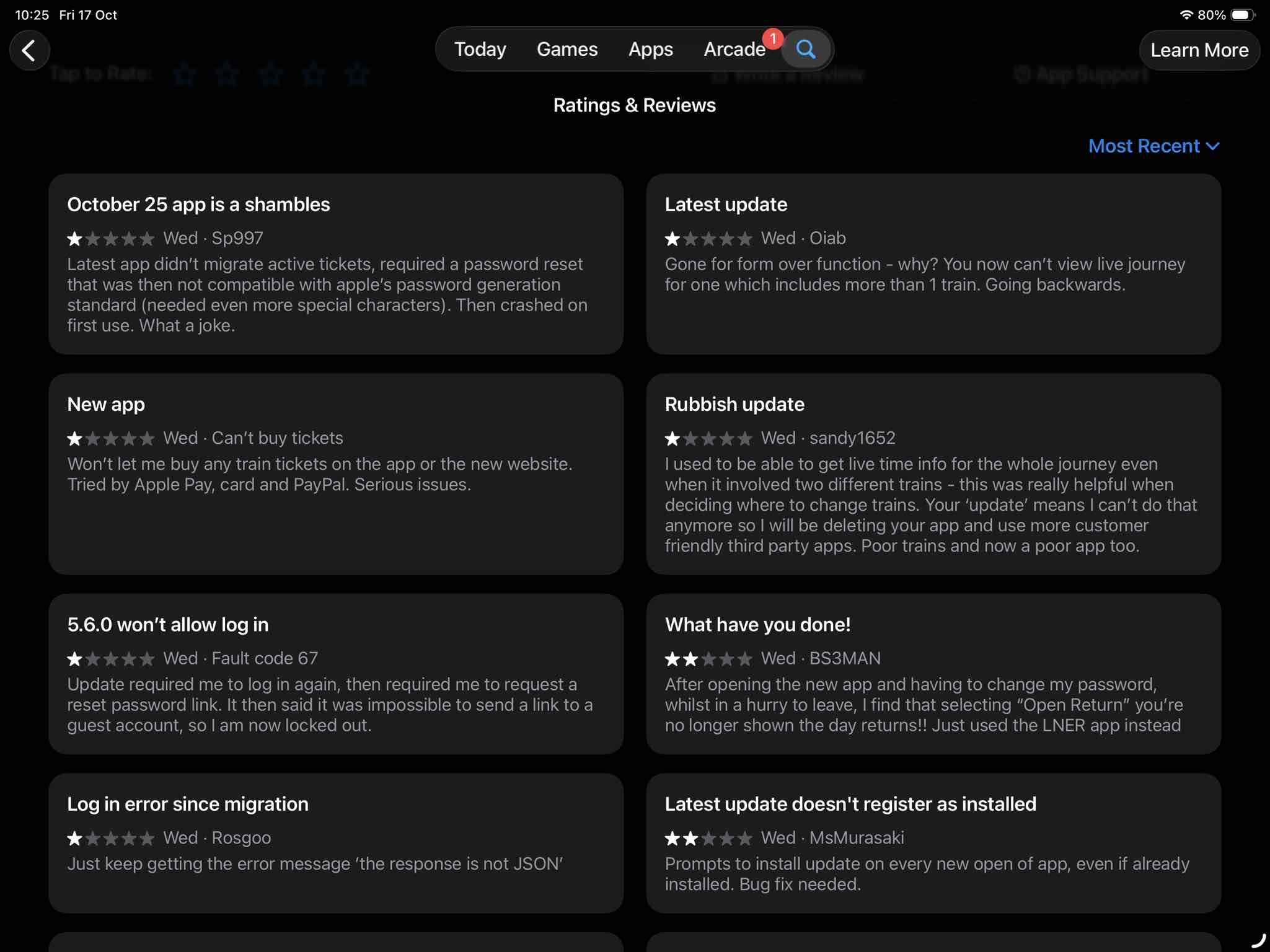
Ho-hum. Let the one star reviews begin:

One day….

Our phones are not your computers

It is common to find software developers who imagine that everyone shares their understanding of, and enthusiasm for, computers. This is not the case. Most people merely tolerate computers:

This leads them to assume that we would like to have our phones transformed into something akin to a computer from the 1990s. This also is not the case. For example Brent Simmons argues that iPhones and iPads should be able to download software from anywhere just like computers because “those devices are computers“. No. They are not computers.

Certainly a phone has all the internal gubbins just like a computer. But my TV comes with a screen, a processor, an operating system, a web browser and is connected to the Internet. It is not a computer. Refrigerators come with processors and screens and an Internet connection. They are not computers. Motor cars come with processors, screens, web browsers and an Internet connection. They are not computers.

Apple sells far more phones than they do computers because phones are not computers. People who want a computer buy a computer. People who do not want a computer buy a phone. Nobody calls their phone their pocket computer… because they are not computers.

I use the splendid NetNewsWire (as mentioned here in 2008) which is available from the App Store for devices that are not computers but, alas, only from the website for Mac computers.

NHS/Accurx – privatisation and missed appointments

Back in June I happened to read through some unimportant looking mail before it was dropped in the recycling. It informed me that an NHS appointment had been made for me on Saturday July 12th. Why and by whom was a mystery. It certainly was not me. There has been much made lately of the cost to the NHS of missed appointments – some (make up a number) millions/billions of pounds. Perhaps they are missed because people are unaware that they exist.

Fortunately today we can rely on technology to save us. It was a simple matter to cancel my appointment via the services of Accurx and their “easy-to-use platform where patients and healthcare professionals communicate“.

Alas communicating the cancellation did not progress any further than the Accurx box ticking exercise. Two text messages arrived, on the Wednesday and Friday, reminding me of the pending appointment. On the evening of the 12th a lady called to ask why I had not attended. I explained I had cancelled the appointment and she apologised in a manner that suggested this was a frequent occurrence.

This failure came as no surprise to me. In the past I have been advised about the results of a blood test – for someone else. I have been invited to partake in some research – for which I did not qualify.

My experience seems to be a common one given all the one star reviews for Accurx. Although medical professionals seem to love it.

The Accurx Principles are hosted on a Notion site (Notion being some ‘AI’ nonsense) and is full of the vacuous drivel one would expect: “If we disagree, we commit and champion”.

Looking into who these people are we sink into the dark and depressing waters that is the gradual privatisation of the health service. Early investors seem to be Conservative MP Tom Tugendhat and Atomico making Irina Haivas – “My passions remain rooted in deeply disruptive technologies, the people who drive them and the opportunity to create meaningful impact at scale — especially in Europe.” a director until she left Atomico in 2025. Laurence Bargery, a co-founder of Accurx, has moved on to Healthtech 1; a UK division of the American corporation Healthtech X.

Accurx, despite having millions invested, have yet to make any money. Of course making money is not the objective. With the whole world (and beyond) becoming little more than a playground for billionaires just getting a foot in the door is enough for now. Keep Our NHS Public maintains a database that catalogues the millions of pounds we pour into these private companies.

While they are busy innovating and disrupting we are left paying for an increasingly inefficient and ineffective health service.