Shove Lemur from an iPad on a Mac

Adapted from this Windows tutorial…

It is much the same procedure but as the Mac speaks fluent MIDI there is no need to add anything.

Ingredients:

A Mac
Ableton Live
iPad
Lemur app
Shove template
ClyphX/Push folders
(Requires a RAR Unpacker if you do not have one)

Procedure:

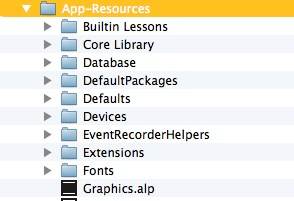
Right click on the Ableton Live icon and select Show Package Contents

showpack

Drill down to the MIDI Remote Scripts folder

contents

appres

MIDIrem

Rename the Push folder as Original_Push

Unpack the RAR file containing the ClyphX/Push folders and put those folders in the MIDI Remote Scripts folder

If your WiFi network is liable to interference/lag you should create an ad-hoc network. The video below just connects via the regular WiFi network.

adhoc

In the iPad’s WiFi settings select your ad-hoc network if you created one

Start the Lemur app and load the Shove template from the Lemur editor on the Mac

In the Mac’s MIDI/Audio set up Utility select the Network button

Connect the iPad to the Session

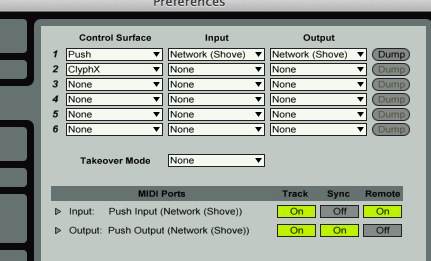
Open Ableton Live and then its Preferences

Select Push and Cyphx as Input Devices and the network session as Input and Output

livepref

Shove away…

Minecraft is not damaged and should not be moved to the Trash

I will usually dismiss most applications that claim to work across Macs/Windows/Linux as not worth downloading to take a look at as they are usually written with Java and so they will be slow and clunky and ugly. [wikipop]Minecraft[/wikipop] is the exception that proves the rule.

It seems a fairly common problem on a Mac that Minecraft refuses to run reporting that it is damaged and needs to be Trashed…

Minecraft damaged warning window

Although my son has had it running on his own account on this Mac (OS X 10.8.3 / Java version 1.7.0_07) it has never worked for me. The official fix suggests that it is related to the Mac’s Gatekeeper and you should right click on the Minecraft icon, select Open from the menu and then Open again in the warning window. This did not work for me.

There are various fixes suggested on various forums but none seemed relevant to my problem. Mac apps, beneath the single icon, are bundles of all the various bits and pieces that the app requires. I went mining into the app with a right click and selecting Show Package Content….

Show Package Contents

and I found the Java (.jar) file to launch Mincraft… MinecraftLauncher.jar which was in the Java folder which was in the Resources folder which was in the Content folder
(or in the order of opening … Content > Resources > Java > MinecraftLauncher.jar)

Double clicking the MinecraftLauncher.jar file opens the Minecraft window, and you can log in, and it downloads the bits it needs, and then… it crashes 🙁

Looking through the crash log there was mention of LWJGL (Lightweight Java Game Library) files and so they were updated from the LWJGL site.

These need to go into the Application Support within the Library. Select Go from the Finder menu and then Library (if you do not see Library listed hold down the Alt key). From the Library folder select..

Application Support > Minecraft > bin

and pop the lwjgl.jar and lwjgl_util.jar files into there. Then in the Natives folder add your other lwjgl files.

Now double clicking the Minecraft icon opens a window… that informs you that Minecraft is damaged and should be dumped in the Trash… but double clicking the MinecraftLauncher.jar icon opens the Minecraft window and away you go 🙂

MInecraft working

To save digging down to the launcher everytime I right clicked on it and selected “Make Alias” to make a shortcut icon that I dragged onto the Desktop.

Lazy Sunday

So you find yourself in bed on a Sunday morning and you have flicked through Flipboard on the iPad when you remember that the new [wikipop search=”EPUB”]ePub[/wikipop] edition of Programming in Objective-C by Stephen Kochan is on the iMac downstairs. Phew! Downstairs! No problem. We have Prompt with which we can log into the sleeping iMac and [wikipop]mv[/wikipop] the book into the iMac’s Dropbox folder from which automagically it appears in the iPad’s Dropbox and then opens in iBooks.

Of course you could just get the iBooks version 😉 but where’s the fun in that?

Lazy Sunday = Small Faces…

…and thence Stanley Unwin.

Menu Bar Clutter

Well as you asked so nicely

Right now it looks like this…

From the left:

  • Hot Mouse Flower – a virtual keyboard thingy.
  • SoundFlower – rewires sound between your apps.
  • Found – a searcher that comes and goes – seems to hog a lot of CPU at times.
  • Vienna – RSS reader.
  • Littleipsum – comes and goes as required.
  • Dropbox – cloudy goodness.
  • Cookie – clutter clearer.
  • Growl – venerable growler.
  • Interarchy – FTP goodness.
  • ClipMenu – clipboard manager.
  • 1Password – password manager which I rarely use from the menu bar.
  • FreeMemory – shows (and reclaims) the free memory you thought you had.
  • BwanaDik – IP/Network displayer now discontinued but still going strong with Mountain Lion. Note the Zappa reference.
  • ClipTwin – quick clipboard swap with the iPad.
  • Caffeine – keeps me and the Mac awake.
  • PopClip – how did we ever manage without it?
  • And then the Mac’s regular Messages, AppleScripts, BlueTooth, Time Machine, WiFi, Clock, User switcher, Spotlight and Notifications.

Last time we looked (February 2010) it looked like this.

The return of the one star whingers.

While one does not begrudge Apple their current mass market success one can sometimes long for the good old days when they only managed to sell computers to discerning sensible people.

Well done Johnny433! You managed to download and install Mountain Lion that’s five stars from me right there but then…

Oh dear! Was there some part of the App Store’s description of Mountain Lion that you did not understand?

To clarify: the latest Macs come with the latest Intel processor known as [wikipop]Sandy Bridge[/wikipop] which was launched in 2011 and features [wikipop search=”Intel Quick Sync Video”]Quick Sync[/wikipop] that can pump video (encoding and decoding) without troubling the main part of the CPU. So if you do not have the latest Macs with the latest processors you will not be able to use Mountain Lion’s AirPlay Mirroring (note: “AirPlay Mirroring requires a second-generation Apple TV or later, and is supported on the following Mac models: iMac (Mid 2011 or newer), Mac mini (Mid 2011 or newer), MacBook Air (Mid 2011 or newer), and MacBook Pro (Early 2011 or newer).”) you can set up some other form of mirroring (there are numerous options depending on your particular needs) that will be passed through the CPU.

Copies of this piece can be saved on to a floppy disc and mailed to you via the postal service if you feel that the march of technological progress is passing by too rapidly.